Review of “Knowing” – Nicolas Cage Owes Me Big-time
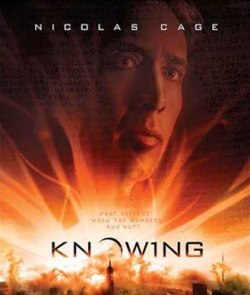 Spoilers ahead…
Alex Proyas, director of “The Crow”, and “Dark City”, had to have been swigging cold medicine from a jug while making his latest film “Knowing”.
John Koestler, widowed professor of astro-fizzy-mo-something, is played by Nicolas Cage. Or Marvin the depressed robot from “Hitchhiker’s Guide to the Galaxy”. I could never really tell which. Cage (It really is him, according to the credits) struggles with the meaning of life since the passing of his wife, drinks a lot, and is preoccupied with telling his son Caleb (Chandler Canterbury) to do his homework and go to bed.
Caleb swipes an artifact from a time capsule that was buried in 1959 because “it might mean something”. On it are scribbled apparently random numbers. Apparently random, that is, to everyone except Cage’s character who almost immediately deciphers the list which contains the dates of every major disaster for the last 50 years.
The audience is led laboriously along a meandering, but well rehearsed, path populated by dreary throw-away characters you care less about than the rubber-masked background extras in later “Planet of the Apes” movies. It’s an hour or more into the story and we’re in the home of the crazy woman who, as a child, wrote out all those numbers that were “whispered” to her. What does she use for wallpaper? Hundreds of newspaper articles about past disasters. Closeup of a date. And another. Another. Another. We get it already!
The final scene: After everyone you didn’t care about on earth gets vaporized by a super solar flare, extraterrestrial ice sculptures deposit the children they’ve saved on an obviously alien world (Make sure we see the extra moons in the sky, the alien wavy-worm grass, those extra moons again. Got it.) Who are they? Why, the “whisperers”.
But that’s not really my biggest complaint. Forget the odd but increasingly predictable mixture of UFOlogy and Christian iconography. I can even forgive the last minute introduction of Koestler’s parents so he can confess that he finally believes in an afterlife (I guess), and will have someone to die with.
Here’s my gripe. “Knowing” is like watching a biathlon. The athlete’s goal is to shoot as many targets as possible in the shortest time. Aim. Fire. Next target. In one scene, Cage’s character slogs through the fiery wreckage of a crashed airliner. 1) Man on fire stumbles by. 2) Look shocked. 3) Make bee-line for the blanket lying beside a second man on fire. 4) Douse flames. 5) Watch people engulfed in explosion. 6) Pull corpse from a shattered window.
Hit your mark, say your line, display emotion R7C4. Every action is programmatic, a method.
Proyas focuses on his characters more than action to move the plot, and I suppose that I’m being overly harsh. But, like the interviewer who is fixated by a gravy stain on the interviewee’s shirt, I’m distracted from the resume. I like sci-fi-end-of-the-world stories. I also respect a director who doesn’t rely on CGI to carry the band (cough .. George Lucas .. cough). Two of the three big “disaster” CGI scenes are brutally violent, and the final vaporization of earth’s surface is very well done. They add to the story without becoming characters themselves.
A few tears shed by Koestler as he hugs his son for the last time would have gone a long way toward washing away some of the gravy stains, but they weren’t in the script, weren’t rehearsed, so they didn’t make it into the final program. “Knowing” is a weekend rental at best, but follow it up with “Deep Impact”, or “When Worlds Collide”.
 Brittle boards pop like firecrackers under my bare feet as I step gingerly across the icy porch. “Sau-aul!” I call out. My breath becomes a million tiny ice crystals reflecting the meager light that spills from the open kitchen door behind me. Beyond the porch railing, the back yard is a broad semicircle of nothingness. Stygian black, completely silent, vastly cold. And roaming around out there is a Stygian-black collie.
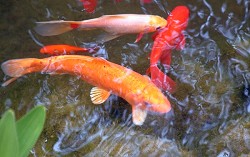 While waiting for the dogs to finish their breakfast this morning, I went out and restarted the waterfall pump for the finally-thawed-out fish pond. It has been an oblong collie ice skating rink for weeks.
 A small audience of herding animals had gathered to watch from the porch above me. First appeared the collie who only eats when it’s absolutely necessary, preferring toast and jam to kibble. Then came the sheepdog who will eat almost anything handed to her, but who will sit in front of her half-full supper dish like a petulant child glooming over cold green beans long after the family has left the table to watch A-Team. And last, licking her lips with relish, came the collie who always waits patiently for the opportunity to helpfully clean up after brother and sister; and sometimes not really waiting for after to arrive.
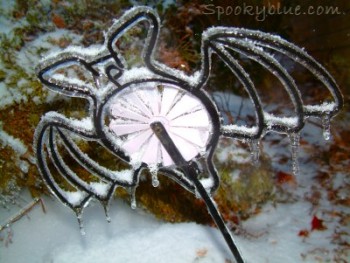 I like a good snowstorm. I like watching it approach on the radar. I like listening to the increased chatter on the police scanner. I even like watching the news stations trip all over themselves the moment the first flake sticks to something and doesn’t melt. An ice storm, on the other hand, is the meaner older brother who wings a slush ball at your head.